Battle Tested Algorithms for Sensor Data
Stop spending resources developing complex machine learning algorithms that miss the mark, when effective tried and tested algorithms already exist.
The data keeps arriving, and the business needs insight.
High-frequency sensor data is unlike any other data. It's continuous, event-driven, and requires distillation into metrics to become useful for the business and your customers. And these metrics are always similar, but different enough to warrant building the proof of concept. The result is the same pattern, repeated across every team working with physical-world telemetry.
You rebuild a similar metric that you have built in the past. It works. The proof of concept goes into production. You continue to build metrics. You realise dependencies are required between them. Algorithm and DAG complexity explodes and data volume grows.
Suddenly you're in the weeds, spending more time maintaining infrastructure than building on top of the metrics to produce business processes that actually matter.
Foundational algorithms. Scalable architecture.
This is how Orca cuts the time to insight by 95%.
Toolboxes
Six toolboxes that cover the full path from raw sensor data to remaining useful life estimation. Each algorithm is statistically guaranteed to work on your timeseries sensor data. Each toolbox is highly configurable and interoperable, implemented within the Orca stack, ready to extend and build on top of.
Architecture
The Orca stack provides a framework for registering algorithms and triggering algoritms over specific regions of timeseries data. It orchestrates this end-to-end process whilst also managing dependencies between algorithms and time window persistence in the event of service failure.
Extendability
Orca exposes all algorithms registered within the stack through a set of automated stubs that that can be auto generated with the CLI. This means you can depend on the results from algorithms written in go, whilst developing in python with full end-to-end type safety.
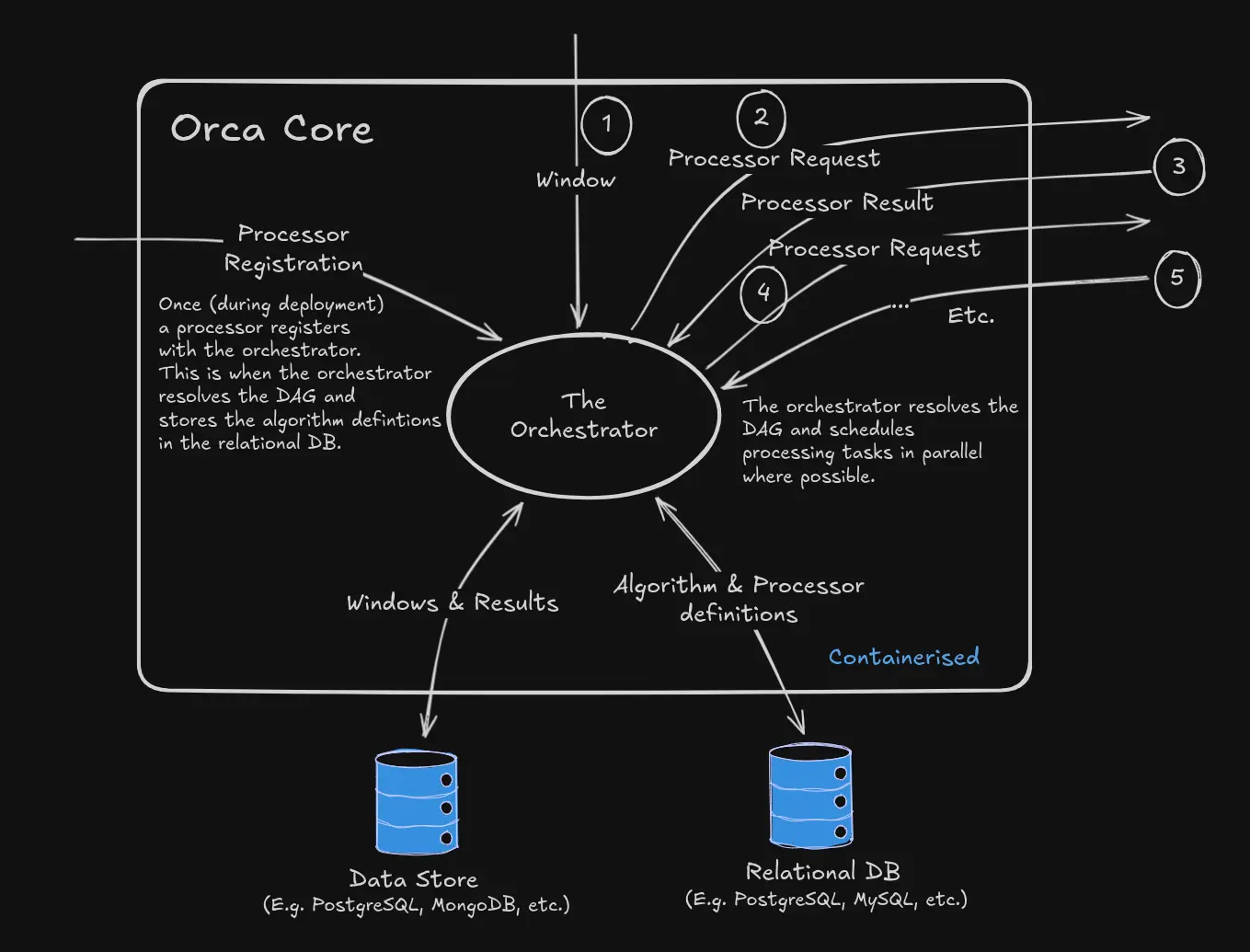
Orca breaks the cycle of algorithm hell by providing a suite of robust toolboxes, that offer critical insight into all kinds of timeseries data. Embedded within a scalable, robust and extendable framework that you can build on top of, without fear of lock-in or rising costs. All hosted in your cloud or on premise.
Production ready algorithms for the problems you keep solving from scratch.
Toolboxes are pre-built, compute-efficient algorithm packages that plug directly into the Orca framework. Developed from real engineering experience in industrial telemetry analytics.
Signal Quality
Detects dropouts, saturation, noise floor, and sampling drift - use it to flag bad data before it poisons downstream analytics.
Condition Indicator
Fuse derived metrics from raw sensor data into a single high-information condition indicator. Use it to simplify prediction targets from 20 metrics to 1.
Deviation Detection
Detect shifts in the underlying distribution of a condition indicator. Catch degradation faster that subject matter experts.
Start using them now
Simplify your stackRemaining Useful Life
Projects asset failure with confidence intervals. Know 2 weeks ahead if failure is occuring, not 2 hours.
Feature Engineer
Automate feature engineering with a set of timeseries and frequency based features, efficient, minimal and effective.
Auto-Label
Auto-generate training data from live fault events with full provenance - build your data moat and gain an edge over the competition.
No migration. No lock-in. Just deploy and go.
Plugs into your existing stack
Orca sits alongside your infrastructure as an orchestration layer, not a replacement for it. It auto deploys into your cloud environment or premise and lets you control data access. Simply point Orca to your data, and let it run.




The core is open source. Forever.
Orca's orchestration engine is open source under an MIT License. Inspect it, contribute to it, deploy it on your own infrastructure. No usage limits, and no bait-and-switch.
Toolboxes are paid. The platform (which will handle deployment, monitoring, and reprocessing in your own cloud) will be paid. The engine that makes all of it work will always be free.
Get StartedAre you fully leveraging your sensor data?
Use Orca and get a kick start on building valuable business metrics on top of your data. Stop letting sensor data burn a hole in your wallet - turn it into a valuable asset, fast!